
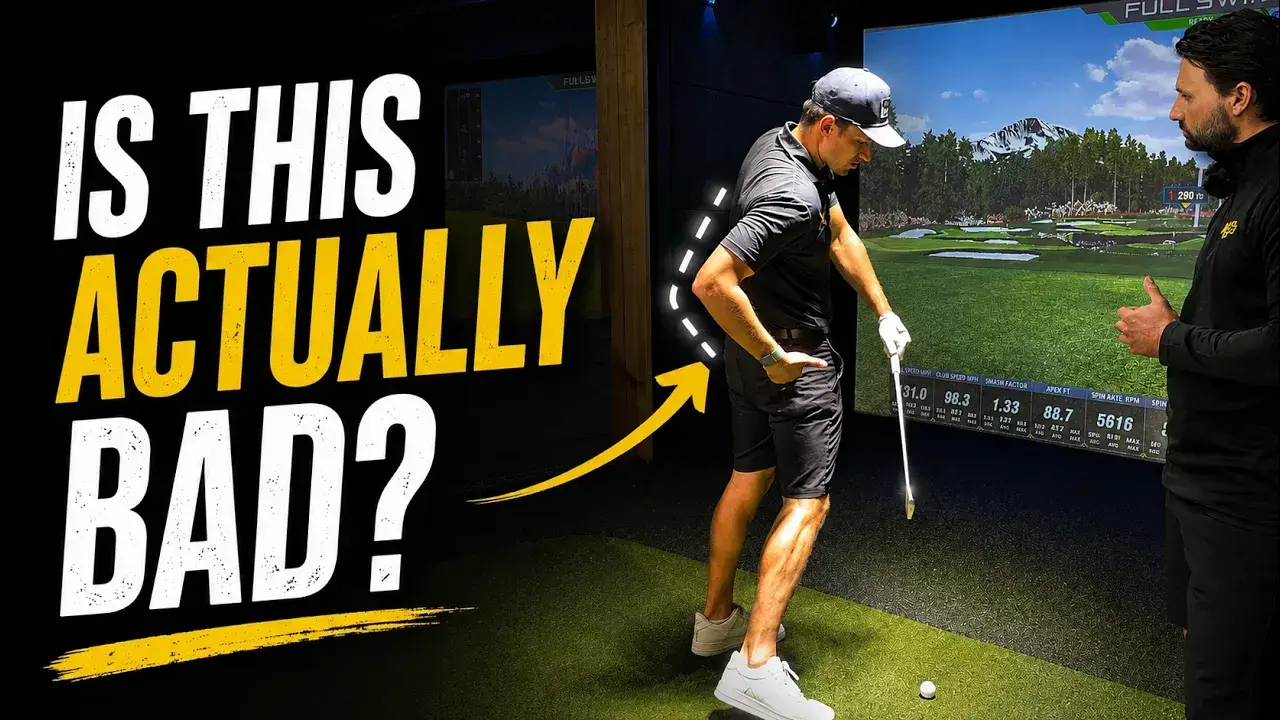
Is Early Extension Actually Bad for Your Golf Swing?
Oct 16, 2026
Film your golf swing from behind and there is a reasonable chance somebody will tell you that you early extend.
Your hips move towards the golf ball during the downswing. Your posture changes. You appear to stand up through impact.
Once it has been pointed out, the usual advice begins:
Keep your backside against the wall.
Maintain your posture.
Rotate instead of thrusting.
Create more space for your arms.
Those instructions can be useful. They can also send a golfer into months of trying to remove a movement without understanding why it is there or whether it is actually causing the problem they want to solve.
Early extension describes something that happens in the swing. It does not explain why it happens, and it does not automatically tell us what should be changed.
What is early extension?
Early extension generally describes the pelvis moving towards the golf ball during the downswing.
As the lower body moves closer to the ball, the torso will often become more upright. This can reduce the space available for the arms and club as they approach impact.
Golfers who do this may describe feeling stuck or trapped. They may need to make a late adjustment with their hands, arms or body to deliver the club to the ball.
Early extension can be connected with a variety of outcomes, including:
-
heel strikes or shanks;
-
blocks and hooks;
-
fat or thin contact;
-
difficulty controlling the low point;
-
reduced space for the arms;
-
inconsistent clubface delivery;
-
difficulty expressing speed efficiently.
That list makes it sound as though early extension must always be removed.
Golf is rarely that simple.
Early extension is a movement characteristic
The first distinction is between describing a movement and diagnosing a problem.
Seeing the pelvis move towards the ball tells us what happened during that particular swing. It does not tell us why it happened.
It also does not prove that the movement is preventing the golfer from playing effective golf.
Some highly skilled golfers demonstrate a degree of early extension and have developed effective ways of organising the rest of the swing around it. Their setup, club delivery, release pattern and physical characteristics work together well enough to produce predictable contact and ball flight.
Another golfer may display a similar-looking movement but struggle with a destructive two-way miss, poor strike and very little control over the clubface.
The movement may look similar on video. Its role within each golfer’s swing could be completely different.
This is why we need to understand the golfer before deciding whether the movement needs changing.
Why might a golfer early extend?
There is no single cause.
For some golfers, it may be connected to the way they use the club. The clubface, swing direction or position of the club during the downswing may create a problem that the body must solve before impact.
If the clubface is very open, for example, the golfer may need to create a late movement that gives them a chance of returning the face to the ball. What appears to be a problem with the pelvis could partly be a response to something happening elsewhere.
For another golfer, the movement may be influenced by their setup. Standing too close to the ball, beginning in a position they cannot maintain or losing balance can all change the space available during the downswing.
Physical capability may also contribute.
The golfer may struggle to control a hip hinge, rotate around one side or maintain balance while producing force. Their body may be using the movement that is most available to complete the task.
Their intention matters as well.
A golfer trying desperately to lift the ball, avoid a slice or create more speed may organise their movement differently from someone simply hitting a familiar shot towards a target.
That does not mean early extension is always caused by the mind, the body or the technique. It means all three can contribute to the movement we eventually see.
Your body may be solving another problem
Movement in the golf swing does not happen in isolation.
Your body is continually responding to the club, the ball, the target and the outcome you are trying to create.
If something earlier in the swing leaves the club in a difficult position, the body will attempt to find a solution. That solution may involve moving closer to the ball, raising the torso, changing the delivery of the hands or rapidly closing the clubface.
Telling the golfer to maintain their posture might remove part of that solution without addressing the original problem.
They may look better during a slow rehearsal but hit the ball considerably worse.
This is why a technically better-looking swing is not always better golf.
The real questions are:
What is the movement helping the golfer accomplish?
What happens to the club when we remove it?
What happens to strike and ball flight?
Can the golfer physically access the movement we are asking for?
Does the alternative still work when speed and consequence are added?
Until we answer those questions, we do not know whether we are correcting a limitation or removing a useful compensation.
When does early extension deserve attention?
Early extension deserves attention when there is evidence that it is limiting the golfer.
That evidence might include:
-
a recurring strike problem;
-
a two-way miss connected to late clubface adjustments;
-
difficulty controlling low point;
-
discomfort during or after the swing;
-
an inability to produce the desired shot;
-
loss of speed or inefficient force production;
-
a movement that becomes less functional under pressure;
-
physical restrictions that reduce the golfer’s available options.
Even then, identifying early extension is only the beginning of the investigation.
We still need to understand where it comes from and which intervention gives the golfer the best chance of improving.
The answer could involve technical coaching. It could involve improving physical capability. It could involve changing the setup, the golfer’s intention or the way they are trying to deliver the club.
Often, it will involve a combination.
Should you use early-extension drills?
A drill can help if it addresses the right problem.
Exercises involving a chair, wall or alignment stick can give a golfer useful feedback about how their pelvis is moving. They can create awareness and help someone explore a different movement.
The problem comes when the drill is treated as a universal solution.
A golfer may be able to keep their pelvis against a chair during a rehearsal and still return to their usual movement as soon as they hit a ball. The ball introduces strike, clubface control, speed and consequence. The task has changed, so the body returns to the solution it trusts.
That does not mean the golfer is incapable of learning.
It may mean the drill has not addressed the reason the movement appears.
Before committing to a drill, ask:
-
What problem is this drill intended to solve?
-
Is that problem present in my golf swing?
-
What happens to my strike and ball flight when I use it?
-
Can I produce the movement at normal speed?
-
Does the change improve my golf or merely change how the swing looks?
Those questions matter more than whether the drill is popular.
Assess the body-swing connection
Physical screening can help determine whether a golfer has the movement options required by the technical change being proposed.
A coach might investigate:
-
hip-hinge control;
-
lower-body rotation;
-
ankle and hip mobility;
-
balance;
-
pelvic control;
-
trunk-to-pelvis separation;
-
lower-body strength and stability.
A limitation in one of these areas does not automatically prove the cause of early extension. A movement screen provides evidence, not a complete diagnosis.
The useful step is comparing the physical findings with the golf swing, ball flight, strike pattern and the golfer’s experience.
If the golfer can demonstrate the required movement away from the golf ball but loses it whenever they swing, the main limitation may not be physical.
If they cannot access or control the movement in simpler tasks, repeatedly demanding it in the golf swing may be unrealistic until their physical options improve.
This relationship between the body and swing is why isolated technical advice does not work equally well for everybody.
Judge the result, not just the appearance
If early extension appears in your swing, resist the urge to decide immediately that it must disappear.
Start with the golf.
What is your normal strike pattern?
Where does the ball start?
How does it curve?
Which misses keep returning?
What happens when you try to maintain your posture?
Does contact improve?
Does the clubface become easier or harder to control?
Do you gain space and speed, or do you lose a movement that was helping you reach the ball?
Video can show you that a movement exists. It cannot, by itself, tell you what that movement means within your golf.
The swing, body, intention and resulting shot all need to be considered together.
Understand why the movement is there
Early extension can limit a golfer. It can also be a functional part of the way somebody currently produces a golf shot.
The goal is not to defend every unusual movement or make every swing look the same.
The goal is to identify which factors are genuinely restricting performance and which ones can safely be left alone.
That begins with investigation.
Before trying to eliminate early extension, understand what is producing it, what it is connected to and what happens when it changes.
Your swing should not simply look better on video.
It should help you play better golf.
Find the relevant connections in your golf
Your swing, physical capability, intentions and ball flight are connected. The free Macro Golf Match-Up Audit helps you explore those four areas and identify where the most useful questions may sit.
Stay connected with news and updates!
Join our mailing list to receive the latest news and updates from our team.
Don't worry, your information will not be shared.
We hate SPAM. We will never sell your information, for any reason.